
Press release
Upright launches CSRD double materiality assessment database for 50,000+ companies
The launch provides investors and companies with science-based, comparable double materiality assessments at unprecedented scale.

Pauliina Bogdanoff
VP, Marketing & Communications, Upright
Published Mar 11, 2025·Updated Sep 16, 2026
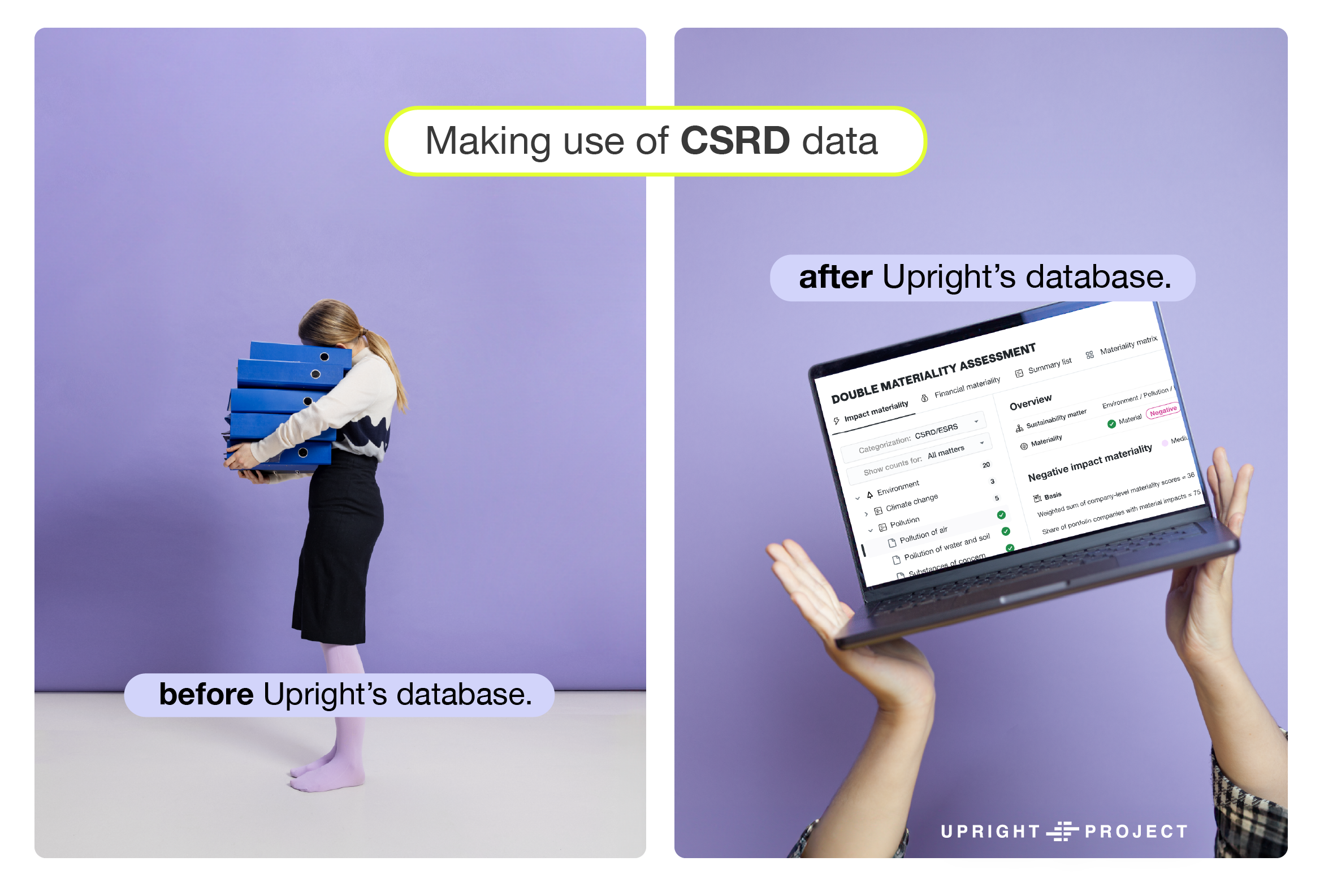
- First-of-its-kind scalability: Covering over 50,000 companies, the launch marks the first-ever database of CSRD double materiality assessments at scale.
- Serving companies and investors: Companies can benchmark material impacts, risks, and opportunities across competition, while investors integrate structured data in portfolio management instead of relying on subjective ESG surveys.
- A comment toward the EU Omnibus: This launch comes after the EU’s new Omnibus proposal reducing sustainability reporting requirements, with Upright proving that scaling back ambitions is not the only option to make reporting lighter for companies.
- Based on 8 years of innovation: The new data builds on Upright’s 8 years of product development in science-based impact quantification based on companies’ products and services.
Upright, the impact data company building science-based ways to measure the real-world impacts of economic activity, has launched an unprecedented database on scalable and comparable double materiality assessments, now covering over 50,000 companies.
With the EU’s Corporate Sustainability Reporting Directive (CSRD) setting detailed standards for corporate impact disclosure, companies and investors alike face mounting pressure to conduct rigorous double materiality assessments. However, as the framework leaves a lot of room for interpretation, many struggle with setting materiality thresholds, comparing assessments across companies, and navigating the latest regulatory updates – including the recent Omnibus proposal.
Decreasing reporting burden with the latest technology
Upright’s latest launch tackles these challenges head-on, providing an automated data engine to assess double materiality at scale. Already leveraged by Euro Stoxx 50 companies, unlisted SMEs, and the world’s largest financial institutions, Upright’s platform enables:
- Companies to conduct robust, data-driven double materiality assessments, with an ability to benchmark material impacts, risks, and opportunities against e.g. competitors.
- Investors to go beyond opinionated ESG surveys and integrate the world’s most talked sustainability framework into risk and opportunity analysis.
This innovation is backed by Upright’s eight years of development in impact measurement using large language model technologies. The core feature of Upright’s proprietary data engine is assessing companies’ impacts and resulting risks and opportunities based on the products and services they sell, drawing impact and product information from 300M+ scientific articles, public databases, and company-disclosed data.
Founder & CEO of Upright, Annu Nieminen, said, “CSRD is a huge amount of work that leaves a lot of room for interpretation for companies. There’s a genuine hunger for structured, comparable data – we’ve seen sustainability directors and ESG researchers enthusiastically sharing Excel spreadsheets comparing less than 20 published ESRS reports they’ve managed to find online. That’s why we believe our database of 50,000 data-driven double materiality assessments will be transformative.”
For a preview of our double materiality data, explore an example assessment for Inditex, the world’s largest fast fashion group.
Revealing the blindspot of EU’s Omnibus proposal
Upright’s double materiality assessments provide a structured, transparent, and comparable approach to understanding how companies impact the world – and how the world impacts them. This launch marks a significant step toward making sustainability reporting a driver of strategic insight rather than a compliance burden.
Founder & CEO Annu Nieminen added related to the EU’s recent Omnibus package, “While the EU has typically raced to catch up with global competitors in technological innovation, they are not doing that in sustainability reporting. The recent Omnibus package focuses on reductions – fewer companies, fewer requirements –, while billions of euros from governance costs could also be cut by accelerating technology-enabled efficiency in reporting.”
“The EU scaling back sustainability ambitions because traditional, manual approaches to reporting were burdensome misses the point entirely. CSRD’s vision for comparable, decision-useful double materiality data wasn’t flawed – the execution was. With this launch of data-driven double materiality assessments for 50,000+ companies, Upright wants to show that third-party data providers can decrease the manual burden while maintaining, or even increasing, reporting quality.”
Notes to editors
For more information and exclusive interviews, please contact Pauliina Bogdanoff, Director of Communications at Upright, at pauliina.bogdanoff@uprightproject.com or on +358 44 0241 616.
Download high-resolution images of Upright’s team and product here.
About Upright
The Upright Project is a Helsinki-based independent impact data company and the creator of the world’s largest impact quantification model of the global private sector. Upright quantifies both positive and negative impacts of more than 50,000 businesses, 35,000 funds and 150,000 different product and service categories on the environment, human health, knowledge and society. Today, more than 300 businesses and investors – including e.g. Orkla, Swarovski, European Investment Bank, Pictet, APG and EQT – rely on Upright’s science-based data to comply with regulation and bring real transparency to ESG and sustainability.
March 11th, 2025
Pauliina Bogdanoff
VP, Marketing & Communications, Upright
Share: