
Impact of investing
Why leading GPs no longer rely on disclosures in ESG due diligence
Learn how automated analysis lets you screen full value chain sustainability risks in minutes – for any asset.
Published Feb 23, 2026·Updated Sep 22, 2026
Executive summary
- The problem: Deal timelines in private markets investing are accelerating, but manual sustainability due diligence (DD) still takes days per deal slowing down capital deployment.
- The reality: 83% of PE leaders rate their current ESG DD as suboptimal (Accenture, 2024). The biggest sustainability risks and opportunities often sit outside the target’s own operations – and are therefore missed in ESG DD.
- What’s changing: Leading GPs like Bridgepoint are complementing disclosure-led, manual analysis with automated, outside-in modelling that surfaces material value chain risks, sometimes before formal DD begins.
LPs remain firm in their commitment to sustainability. They don’t trust words – they want rigorous data to validate sustainable value creation.
This puts GPs in a difficult spot: Most targets haven’t mapped their sustainability exposure, and that information is rarely available at the sourcing stage. Yet this is exactly when early screening decisions are made.
The industry's response has been manual ESG due diligence – a process few deal teams actually believe in.
Three reasons why traditional ESG DD is failing private markets GPs:
- Too slow for sourcing. Manual research takes days per deal, which doesn’t work in high-velocity deal environments.
- Looks in the wrong places. Disclosure-based analysis focuses on internal operations, while the most material risks sit in the value chain.
- Deemed “suboptimal” by deal teams. 83% of PE leaders rate their current DD as suboptimal (Accenture, 2024). ESG reports get filed – and ignored in investment decisions.
The GPs pulling ahead are abandoning manual spreadsheets for automated, outside-in modeling that delivers answers before DD even starts.
How an “outside-in” approach identifies material sustainability risks before DD even startsAn outside-in, AI-enabled approach to ESG DD analyses a target’s sustainability risk and opportunity profile starting from what a company actually does – its products, services, and the value chain those sit within – rather than what it discloses.
What outside-in ESG DD enables in practice
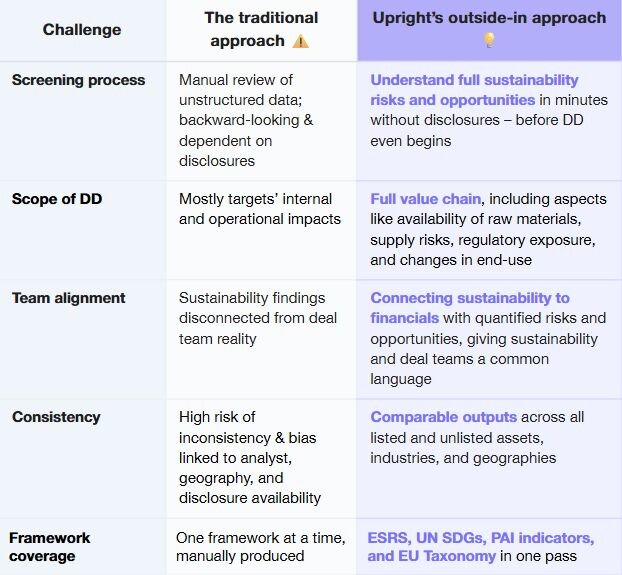
- Identify material risks early. Full value chain risk and opportunity profiles are available in minutes, without relying on target disclosures. Red flags in companies, products, and supply chains can be ruled out before allocating further resources.
- Reduce bias and improve comparability. Outside-in modeling acts as a bias-checker, producing consistent results across industries and geographies and freeing teams to focus on judgment rather than data collection.
- Cover multiple frameworks in one pass. A single analysis can produce metrics aligned with ESRS, UN SDGs, PAI indicators, and the EU Taxonomy.
- Align sustainability with financials. Outputs map directly to revenue exposure, cost of goods, and CapEx risk — giving deal and sustainability teams a shared language.
- Start better management conversations earlier. Entering discussions with a substantive, outside-in view of sustainability exposure changes the tone and depth of engagement.
As Anthony Rowland, Director at Bridgepoint (UK PE firm with $86bn AUM) shared at Upright’s recent webinar:
"The Upright Platform allows us to do some of that work and think outside-in. I'm excited about the opportunity to have a discussion with the management team about these topics pretty early on to say, 'Look, Upright has modelled your business and it's really exciting because X, Y, and Z – interested to understand how you think of these risks and opportunities.'"
Support, not replacement. Outside-in automation doesn’t replace human due diligence – it removes the lowest-value manual work. By consolidating sustainability data at scale, it allows investment teams and experts to focus on interpretation, prioritisation, and decision-making where human judgment matters most.
Traditional vs. AI-era sustainability DD – what the shift looks like
The Upright Platform provides a self-serve workflow that delivers science-based ESG analysis for any asset using only a company website and revenue information.
The table below shows the difference between traditional & Upright’s approach.
Built on eight years of methodology, trusted by leading investors
Upright's proprietary data engine has been developed over eight years, benchmarked across 50,000+ companies, and is trusted by the likes of EQT, APG, and the European Investment Bank.
See it on a real asset – for free
The best way to understand the product is to run it on a deal you're currently looking at.
Book a discovery call with our team – we'll walk you through the platform and, where it makes sense, set up a free trial so you can test for your own use case.

Upright Project
Share: