Sustainability regulation
How US peers tackle California SB 261 and CSRD at once – without doubling the work
(And why traditional approaches will break under assurance)
Published Feb 4, 2026·Updated Sep 22, 2026
Executive summary:
- The challenge. U.S. companies face a dual compliance burden from the EU’s CSRD and California’s SB 261. The hurdle is how to meet both requirements with minimal manual work and audit risk.
- The "report once" opportunity. Because California’s SB 261 explicitly allows for "substantially similar" international reports, companies can consolidate regional requirements into a single global dataset.
- The solution. Leading peers are moving away from subjective workshops and 10-month consulting cycles, opting instead for AI-enabled double materiality assessments to generate one financial-grade baseline that satisfies both regulators
How peers see the increasing regulatory pressure
For US companies with EU exposure, the EU’s CSRD and California’s SB 261 redefine sustainability reporting as a financial-grade exercise, requiring financial relevance, traceability, and audit readiness.
The traditional narrative ESG approach is no longer enough.
Recent surveys of US-headquartered firms reflect the resulting pressure:
- While nearly 90% have collected ESG data for more than a year, only 17% describe their data as audit-ready for CSRD (Source: Semarchy CSRD Readiness Research)
- Despite the regulatory pressure, 74% of practitioners admit their reporting process still relies on manual spreadsheets and fragmented data (Source: Workiva Sustainability Report)
- 57% of US senior executives cite poor data quality as their primary compliance challenge, with documentation and approval close behind (Source: Deloitte 2024 Sustainability Action Report)
The challenge peers increasingly face is how to meet both requirements without multiplying manual work or audit risk.
Why CSRD and SB 261 are increasingly handled together
CSRD and California’s SB 261 differ in scope, but they converge on the same practical requirements: audit-ready justification of materiality and financially relevant sustainability data.
This convergence is explicit:
- SB 261 allows companies to satisfy its requirements using reports prepared under other international standards, including CSRD, if they are “substantially similar.”
- CSRD’s financial materiality is intentionally aligned with TCFD and IFRS / ISSB S2, enabling a “report once” approach for global companies.
As a result, many companies are structuring sustainability reporting around a single, updatable double materiality assessment that can support both CSRD and SB 261.
How an AI-enabled double materiality assessment reduces rework while strengthening assurance
Upright’s AI-era double materiality assessment is designed to support this convergence. It treats double materiality assessments as reusable, evidence-based data, rather than as a one-off reporting exercise.
In practice, this means you get:
- a single double materiality baseline supporting both CSRD and California SB 261, updatable any time
- documented evidence and traceability designed to hold up under limited assurance
- financial materiality aligned with TCFD and IFRS / ISSB S2
- Quantification of risks and opportunities in monetary ($) terms, satisfying the financial data requirements of CSRD, SB 261 and ISSB
…in weeks, not months, using the latest reporting technology.
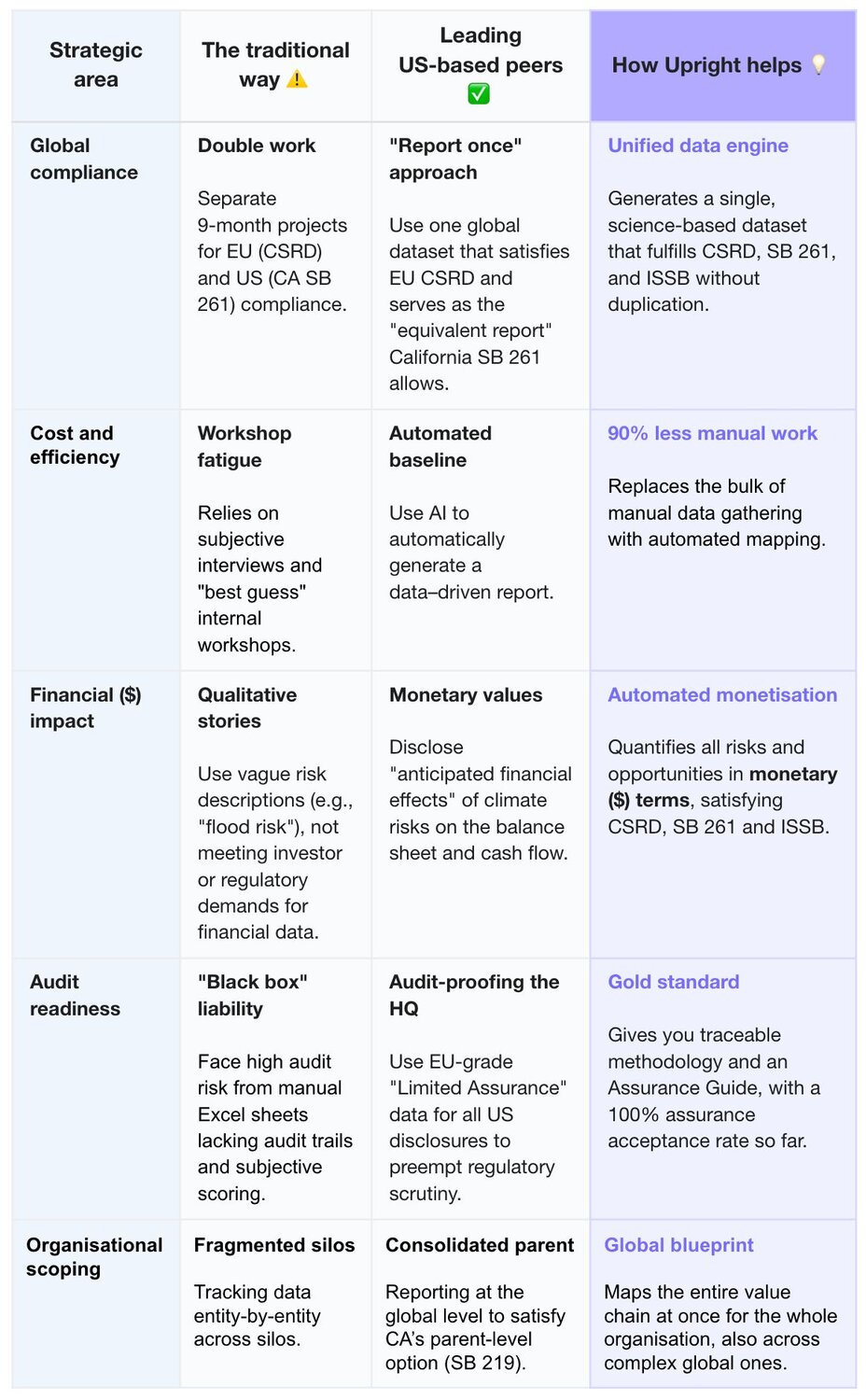
The table below shows how Upright’s approach differs in practice from more fragmented ways.
Traditional vs. Upright way of handling CSRD and SB 261
Automate data collection to focus on what actually matters
At Upright, our CSRD customers have:
- Passed 100% of limited-assurance audits, including reviews by all Big 4 firms
- Across 150+ completed DMAs
- With 90% of customer teams moving away from surveys and workshops altogether
Sustainability reporting was never meant to be a full-time battle of chasing data. That’s why leading peers are moving past the manual mess and meeting aggressive 2026 deadlines with the latest technology.
Want to validate our tool first?
You can run a free double materiality assessment with Upright in minutes to see how it works in practice. For deeper input, tailoring, and ongoing expert support, we offer enterprise solutions.
If this approach might be for you, we’re happy to discuss your data setup.


Upright Project
Share:
