
Impact of investing
Filling the gaps: How to get complete portfolio coverage on PAIs
SFDR demands transparency – but missing PAI data remains a problem for investors. The good news is full coverage is within reach without one-off analyses or relying on averages.
Published Nov 18, 2025·Updated Sep 22, 2026
By Valtteri Vulkko, COO at Upright
Since 2021, Sustainable Finance Disclosure Regulation (SFDR) has required investors to report on Principal Adverse Impacts (PAIs). The rule has pushed the industry toward greater transparency, but the toughest problem remains: the data itself.
Even for common metrics like Scope 3 emissions, company disclosures are incomplete. For more nuanced PAIs – think energy or waste – data is often nonexistent. This leaves investors facing the same frustrating trade-off: either spend time and budget on one-off consultant analyses, or accept that parts of your reports will remain blank.
Both options weaken credibility.
Why missing data is more than a reporting headache
Leaving PAI data blank isn't cosmetic. It creates blind spots that ripple across an investment process:
- Incomplete reporting: Blanks in your regulatory and LP reports can undermine trust, especially with sustainability-oriented audiences.
- Skewed aggregates: Empty PAIs can also skew fund-level aggregates, often overstating negative impacts.
- Hidden hotspots: Blind spots make it harder to identify environmental and social risks that could affect a company's financial performance or reputation.
- Weakened Due Diligence: This is when you most need a clear, consistent picture – and missing data means decisions are made on partial information.
A scalable way to close gaps
Since 2017, Upright has developed a data model that fills disclosure gaps without relying on crude sector averages. Instead of treating all companies in a sector as alike, the model maps more than 150,000 products and services – the largest taxonomy of its kind – to both public and private companies.
Each product and service in Upright’s database carries its own specific intensity across the PAIs. These products and services are mapped to individual companies using revenue weighting to determine their overall impact. For private companies without detailed disclosures on revenue streams, revenue weights are estimated based on business descriptions and financials to build a comparable mapping. With this model, for example, that two pharmaceutical companies specialising in oncology would look very different, if one was concentrated on biological drugs and the other in generics.
The result is full coverage across PAIs, balancing accuracy and scalability in an optimal way. Every quantification is transparent in its assumptions and continuously updated as new product info comes in.
This allows investors, especially those with large portfolios, portfolio-wide reporting that is both defensible and efficient, faster and more cost-efficiently than bespoke consultative calculations.
Accuracy increases significantly when PAIs are modeled at product level over portfolio level
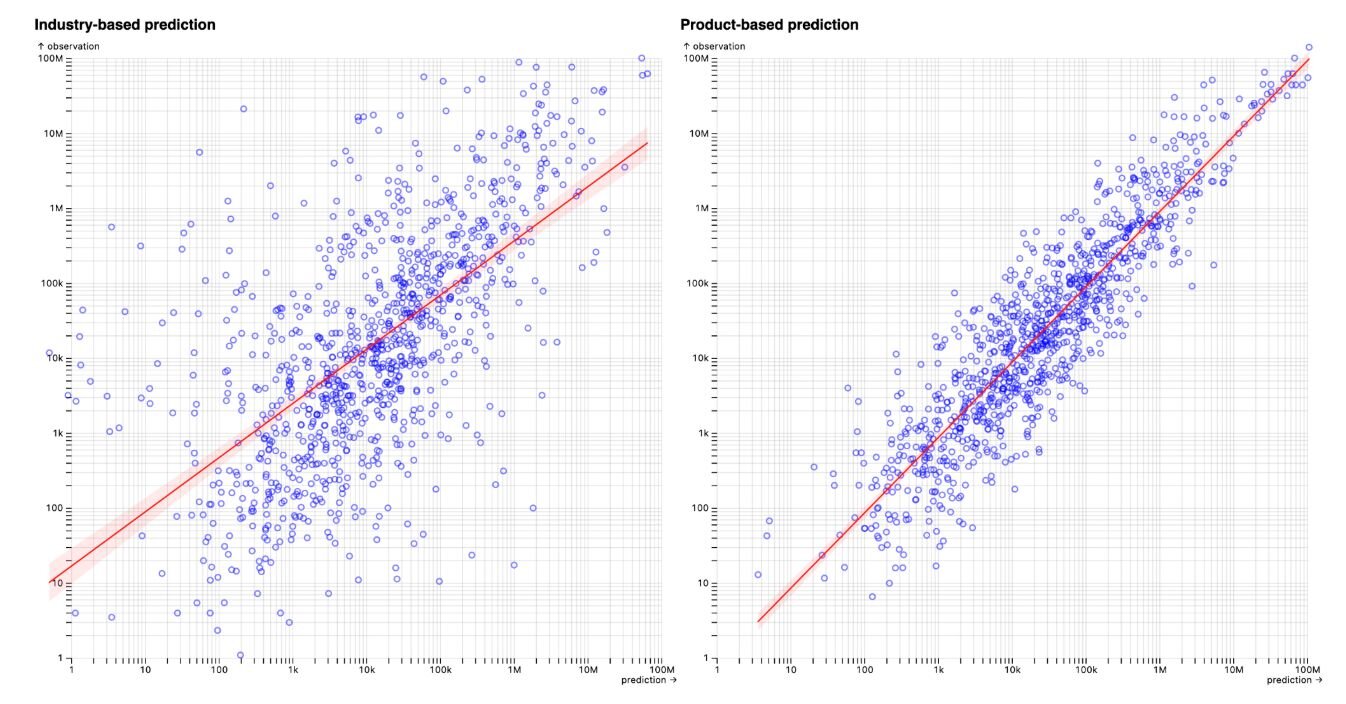
The charts above show predicted versus actual GHG Scope 1 intensity (tonnes per million euros of revenue) using two modeling approaches. The industry-based model predicts emissions using average values for each sector, while the product-based model incorporates detailed product-level characteristics for each company. Each point represents a company entity. While industry-based predictions capture broad trends, product-level modeling aligns much more closely with observed values, reducing scatter and improving accuracy, especially for extreme emissions. This demonstrates the value of granular product data in assessing real-world GHG intensity.
Built for compliance and trust
For any investor, reliability and compliance are key attributes for sustainability data. Upright is already powering sustainability reporting for the likes of EQT and APG , with our estimates are fully aligned with SFDR guidance, which explicitly allows for the use of best effort estimates to fill gaps:
In the absence of directly reported information from investee companies, financial market participants shall use information provided by third-party data providers or other reasonable means to obtain the necessary information.
Upright’s quality assurance process ensures each estimate reflects the latest available data. That means investors can confidently defend their reports to regulators, LPs, and other stakeholders.
As Upright’s CTO, Juho Ojala, puts it:
Our QA methods ensure every data point is a reflection of the latest product and service information we have. This makes our estimates more precise than industry averages, giving investors a clear and defensible picture of their portfolio.
What this means for a private markets investors
With Upright's PAI estimates, you can:
- Achieve full portfolio coverage without leaving blanks in your reports.
- Strengthen due diligence with consistent, comparable data on-demand.
- Show LPs you're ahead of the curve on doing the best effort for transparency.
- Strike the perfect balance between efficiency and accuracy to reach the above.
Don't let missing data hold you back
The need for full portfolio transparency will only increase. With Upright, private markets investors regardless of size and investment focus can meet it head-on – with robust, company-specific estimates that fill the data gaps and unlock new insights.
Ready to see how Upright can help you get a complete view of your portfolio?
Want to hear more about Upright’s PAI estimation from clients and internal experts first?

Upright Project
Share:
