
Measuring impact
What double materiality actually depends on: why 80% comes from your business model, not your stakeholders
Across more than 200 double materiality assessments completed with Upright, a consistent pattern emerges: over 80% of the IROs that end up assessed as material were already surfaced by Upright's data engine from product and service portfolio data, before any stakeholder input.
Published Apr 30, 2026·Updated Sep 22, 2026
If you are spending the majority of your DMA effort on workshops and surveys, you are optimising the wrong part of the process.
Here is what the data shows, and what it means for how you run a DMA.
Key findings
- What a company makes and sells determines the majority of its material topics. The analytical foundation of a DMA is the business model, not the stakeholder list.
- Stakeholder engagement and company-specific inputs surface the remaining share, but they are a validation and prioritisation layer, not the analytical foundation.
- Results grounded in scientific benchmarks have cleared every Big Four audit Upright has been involved in. 200+ DMAs completed, 100% pass rate.
Double materiality in brief
Let's start with a short recap of what double materiality actually requires, because the framework itself explains why the business model carries so much weight. Double materiality sits at the centre of CSRD, but its relevance extends well beyond compliance. Done rigorously, it becomes the analytical foundation for sustainability strategy and feeds directly into other regulatory frameworks, including California’s SB 261, SFDR, and ISSB.
The concept has two independent dimensions. Impact materiality asks where your business causes significant harm or benefit for people and the environment. Financial materiality asks which sustainability factors create risks or opportunities for your cash flows, market position, or cost of capital. A topic can be material in one dimension, both, or neither. Double materiality is the starting point for all sustainability reporting under CSRD.
For a full breakdown of the framework and its regulatory context, see our double materiality assessment guide.
Why your business model is the primary input to a double materiality assessment
Under ESRS, a sustainability matter is material when it meets the criteria for impact materiality, financial materiality, or both. What the framework does not prescribe is how you find those topics, and that is where approach varies considerably in practice.
Stakeholder surveys were long considered the primary discovery mechanism for a DMA. Many companies are moving away from that approach, and the data supports the shift. In practice, surveys rarely surface material topics that a rigorous science-based analysis based on the products and services has not already identified. Their value lies in validation and prioritisation, not in discovery.
Here is what the data shows about where material topics actually come from.
The 80% finding
Since launching its DMA product, Upright has completed over 200 assessments across sectors including finance, technology, industrials, healthcare, and energy. In those assessments, over 80% of material IROs were identified from products and services data alone. Adding geographical data brings that figure to 84%, and with selected sustainability indicators and customer or investment data, 96% of result accuracy is achieved before a single stakeholder survey takes place.
Stakeholder surveys account for 3.9% of material IROs identified across the full sample. These steps remain valuable for validation and prioritisation. They are just not where material topics are discovered.
This is not a coincidence. A company's exposure to sustainability issues is structurally determined by what it makes and sells, and where in the value chain it operates. For example:
- A pharmaceutical company's material topics (access to medicine, chemical waste, supply chain labour conditions) are traceable to its business model and value chain relationships, both upstream and downstream. Accurately attributing impacts, risks, and opportunities across that chain requires structured, comparable data that neither internal teams nor external stakeholders can be expected to produce consistently.
- A logistics company's climate risk is a function of its fleet composition, route dependencies, and downstream delivery networks. These are structural characteristics of the business, identifiable from company and geographical data before any engagement process begins.
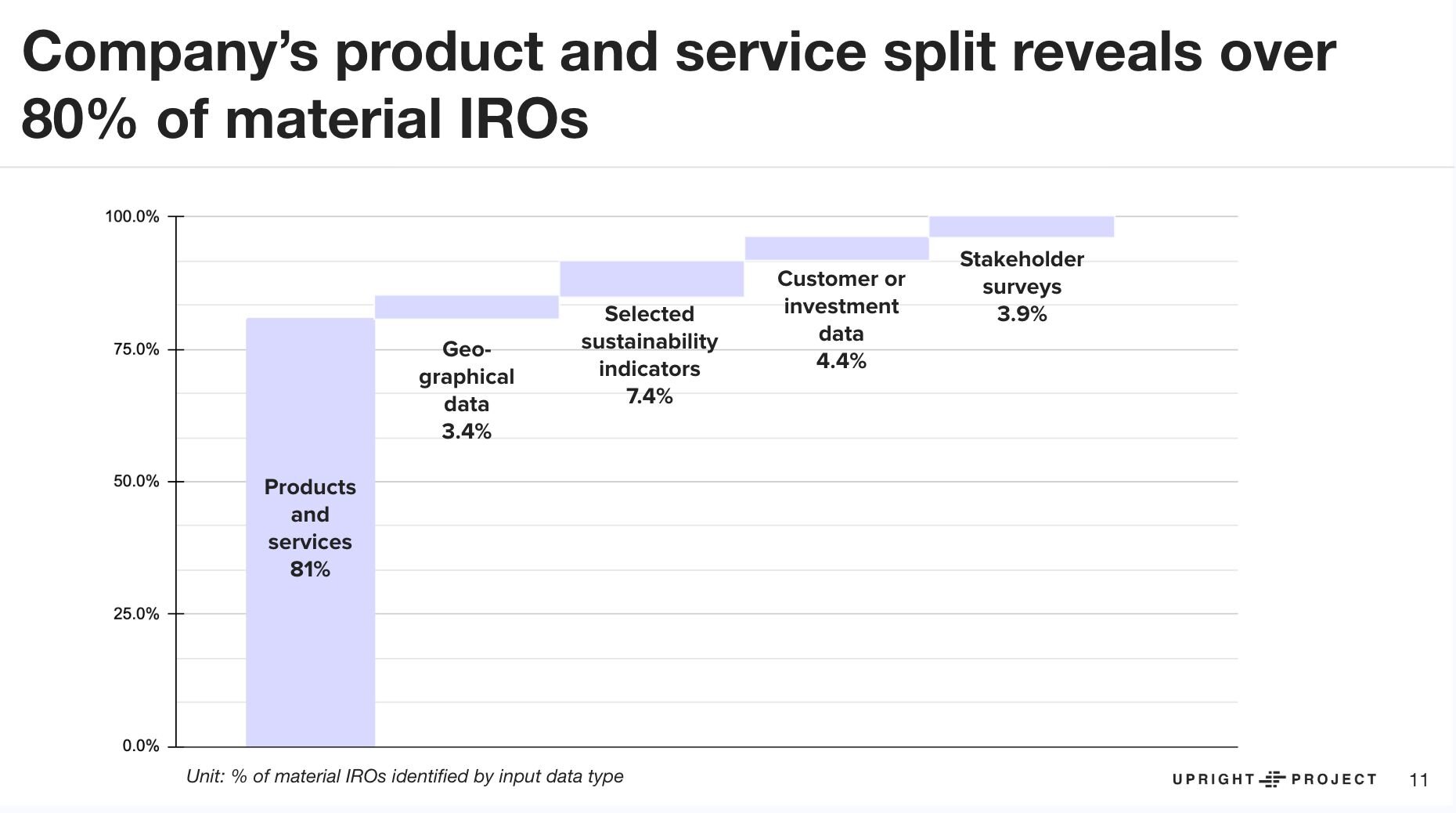
Chart: IROs identified by portfolio engine vs. IROs surfaced through other inputs – 200+ DMA sample. Presented in the Upright webinar Fall 2025
What this changes about how you run a DMA
If 81% of material IROs can be identified from your product and service portfolio alone, and 96% before any stakeholder survey takes place, the effort allocation for a DMA looks quite different from conventional guidance.
Where to concentrate effort: Building an accurate, granular input on your product and service portfolio with clear revenue weights and geographical and sustainability indicators is the highest-leverage step. This is what drives the quality of your results, and where the time investment pays off most clearly.
Where stakeholder input still earns its place: For most companies, formal stakeholder surveys are not a necessary part of the process. The data consistently shows they contribute around 3.9% of identified IROs. Where stakeholder engagement does add value is in results tailoring: internal expert review, sector-specific regulatory additions, and qualitative insight on social topics that quantitative modelling cannot fully capture. These steps matter for validation and prioritisation. They are not where material topics are discovered.
How to update a double materiality assessment: Your previous assessment can serve as the starting input, meaning the process requires minimal additional effort and no stakeholder surveys. This also makes the model particularly well-suited to structural changes in the business; an acquisition, for example, simply requires updating the product and service portfolio data, and the DMA updates accordingly.
What this means for audit readiness: Results grounded in scientific benchmarks and structured company data produce cleaner audit trails than conclusions derived primarily from stakeholder opinion. All Big Four firms have greenlit Upright's methodology. The 100% pass rate across 200+ audits reflects a process built on verifiable, reproducible data.
How the process works in practice
Step 1 – Input data: Submit your products and services with revenue weights, geographical data, selected sustainability indicators, and financial statements. If you are updating an existing DMA, your previous assessment can serve as a starting input, making the process significantly faster and requiring minimal additional stakeholder involvement.
Step 2 – Science-based analysis Upright's data engine identifies material impacts, risks, and opportunities across all 80+ ESRS topics, covering both impact and financial materiality. Your company data is integrated with 300M+ scientific articles from Oxford University's CORE database and public databases, and results are benchmarked against 57,000+ companies.
Step 3 – Results, delivered Access your DMA results, visualisations, methodology document, assurance guide, and list of ESRS data points.
Step 4 – Results tailoring Fine-tune IROs and align thresholds based on your previous DMA work or internal expert opinions. This is where stakeholder insight and internal review feed in, shaping the final portion of topics that science-based analysis alone does not determine.
To understand how Upright's data engine produces these results, read the full CSRD methodology. For the complete framework and regulatory context behind double materiality, see our double materiality assessment guide.

Upright Project
Share:
