Sustainability regulation
Q&A: What is CSRD's double materiality and how to tackle it with Upright?
The looming CSRD regulation is causing headaches to many sustainability professionals. Upright's VP of Corporates, Markus Weckman, breaks down EU's latest regulatory requirements.
Published Jun 29, 2023
What is CSRD?
The Corporate Sustainability Reporting Directive (CSRD) is a new set of legislation by the EU, which requires a broader set of large companies, as well as listed SMEs, to publish regular reports on the social and environmental risks they face, and on how their activities impact people and the environment.
What is the point of CSRD?
The CSRD has a few key objectives:
- Ensure that investors and other stakeholders have access to the information they need to assess investment risks arising from climate change and other sustainability issues.
- Create a culture of transparency about the impact of companies on people and the environment.
- Reduce reporting costs for companies over the medium to long term by harmonizing the information to be provided.
Who is affected by CSRD and when?
Large public interest entities with 500+ employees will have to apply the new rules for the first time in the 2024 financial year, for reports published in 2025. Large unlisted companies and listed SMEs will follow in the subsequent two years. In total, approximately 50,000 companies will be subject to the CSRD.
Companies subject to the CSRD will have to report according to European Sustainability Reporting Standards (ESRS). The European Commission adopted the Delegated Act on the first set of ESRS on July 31, 2023. The act will be formally transmitted in the second half of August to the European Parliament and to the Council for scrutiny. The scrutiny period runs for two months, extendable by a further two months. The European Parliament or the Council may reject the delegated act, but they may not amend it.
What is ESRS?
ESRS (European Sustainability Reporting Standards) includes 12 separate standards of which two are cross-cutting standards (ESRS 1-2) applying to all sustainability matters, while ten are topical standards covering environmental (ESRS E1-E5), social (ESRS S1-S4) and governance (ESRS G1) matters.
Cross-cutting standards ESRS 1 (General requirements) and ESRS 2 (General disclosures) are mandatory for all reporting companies. Reporting according to topical standards is subject to double materiality assessment, in which the company needs to identify the material impacts, risk and opportunities to be reported.
What does a double materiality assessment mean?
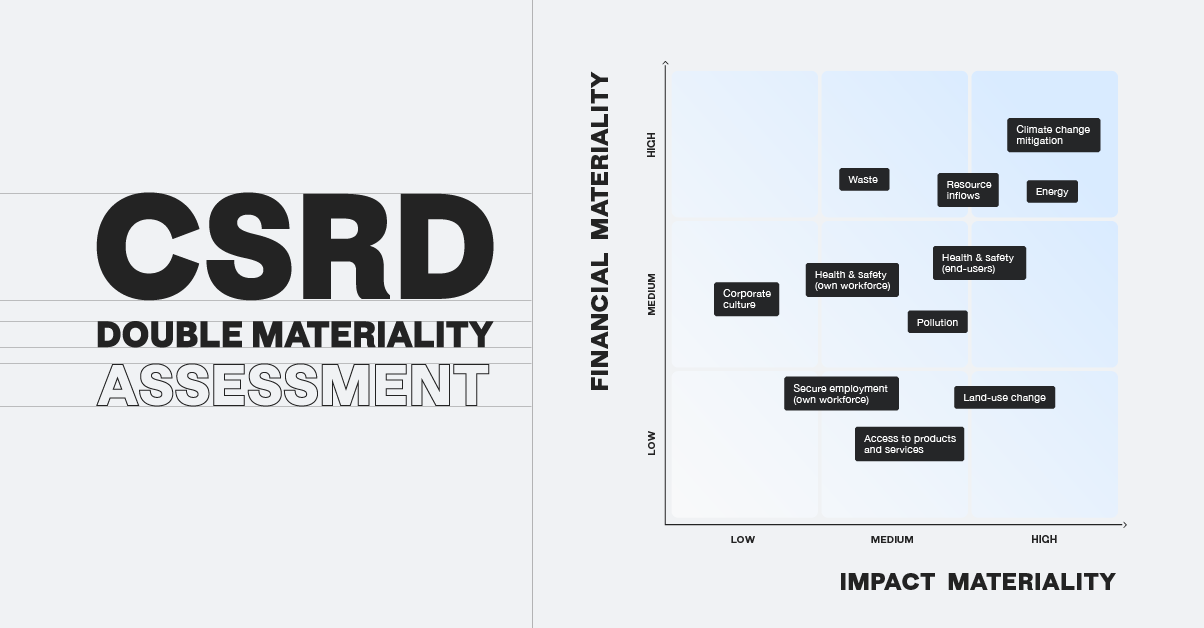
Double materiality assessment has two dimensions: impact materiality and financial materiality.
- Impact materiality assessment aims to identify sustainability matters which have material actual or potential, positive or negative impacts on people or the environment. Impacts include those caused by the company and its upstream and downstream value chain.
- Financial materiality assessment aims to identify sustainability matters which may trigger material financial effects on the company. This is the case when they may generate risks or opportunities that are likely to have a material influence on the company's financial performance such as cash flows or cost of capital.
What should a double materiality assessment include according to ESRS?
In its double materiality assessment, a company should consider sustainability matters described in ESRS (~90 categories in total) as well as develop entity-specific disclosures on material impacts, risks, and opportunities not covered by ESRS. To determine the material matters, the company needs to adopt appropriate thresholds for materiality.
The outcome of the double materiality assessment is a list of sustainability matters that are material and not material for the company.
For the material sustainability matters, the company has to follow the detailed disclosure requirements on actions, policies, metrics, and targets described in the topical standards. For the non-material sustainability matters, the company may omit these topical disclosure requirements.
Upright's AI-enabled, science-based data engine can now be used to conduct double materiality assessments without tedious data exercises, interview rounds, or other time thieves.
Learn more about Upright's double materiality offering:
June 29th, 2023
Upright Project
Share: