Introducing Eevo
The first consequential decision model, built for supporting AI agents’ judgement, trained to excel at comparative sizing of consequences and estimating expected value.
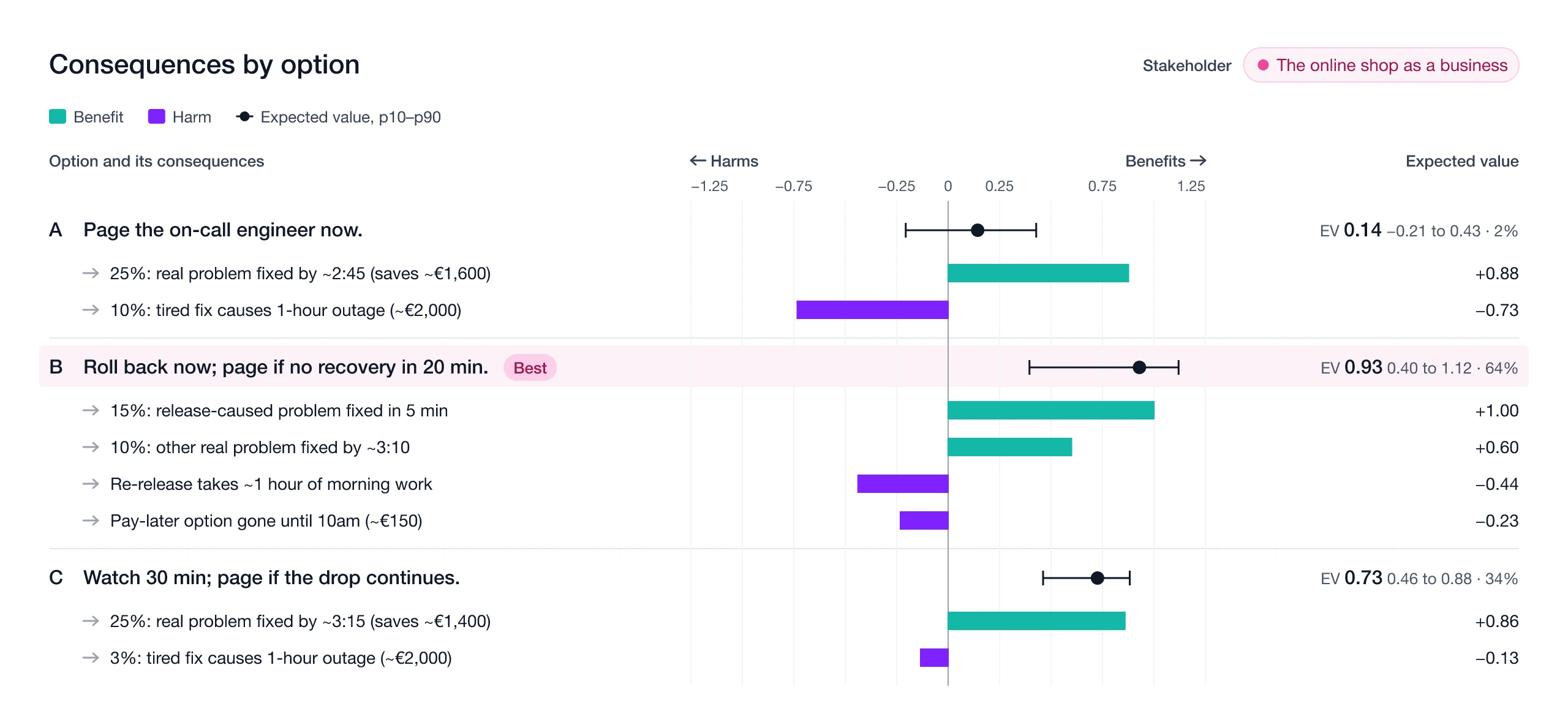
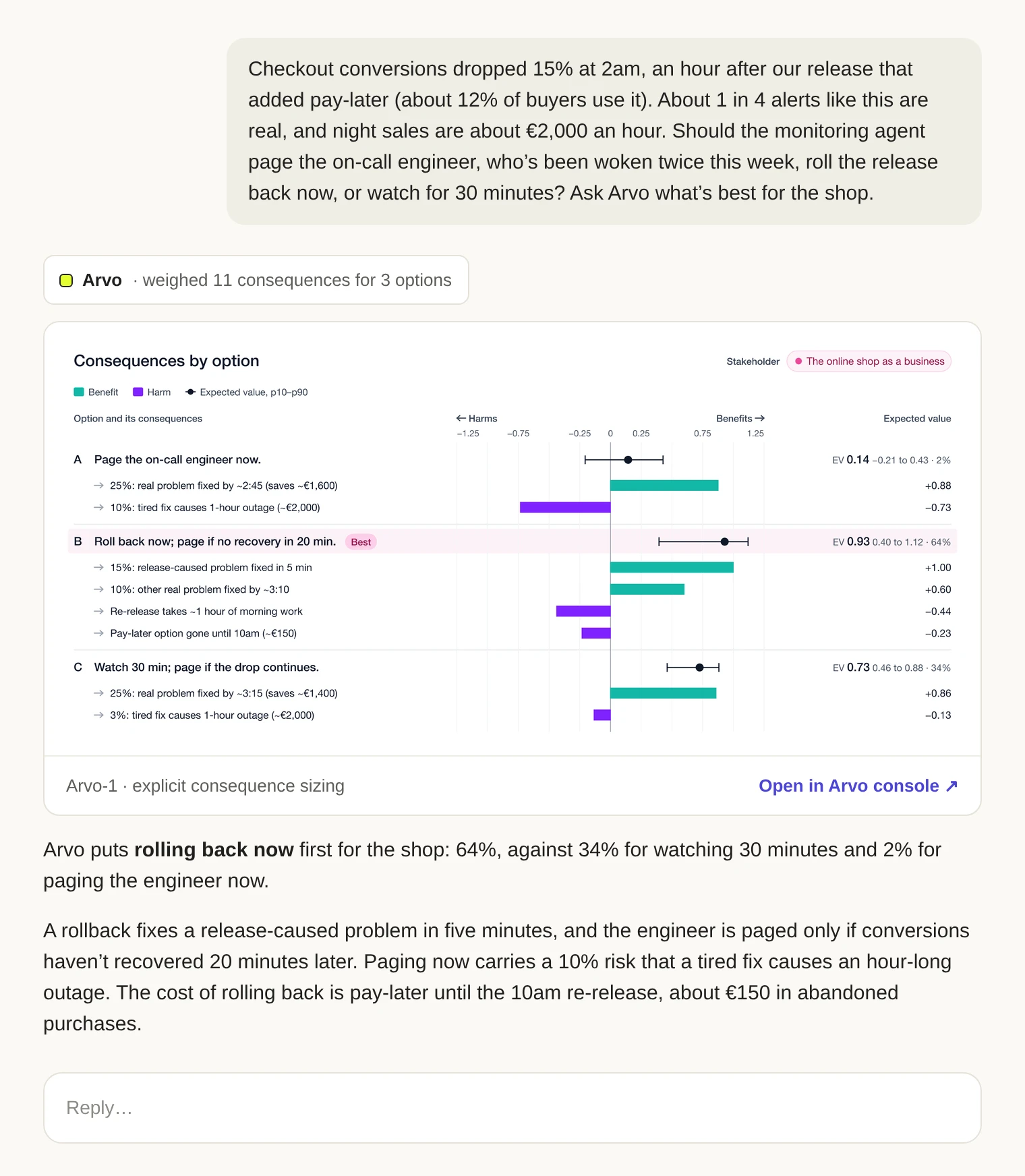
A monitoring agent sees checkout conversions drop 15% at 2am, an hour after a release. Wake the engineer, roll back or keep watching? Eevo sizes the chance the problem is real, the risk of a tired fix and the cost of losing customers on one scale. Rolling back first comes out best.
Today we’re introducing Eevo, Upright’s consequential decision model. It is built for AI agents that need to make judgement calls, from coding and operations to customer-facing decisions, and, we suspect, a whole lot more.
Give Eevo a decision, the options, and whose interests count. It weighs the consequences of each option and returns, for each stakeholder, the option with the highest expected value, and a calibrated probability for every option.
And why does this matter? Because the real world doesn’t follow rules.
Every day, agents (like humans) encounter situations nobody anticipated, and they still have to choose: a fix that helps some customers but risks others. A refund that falls outside policy. Saving today vs. saving in the future.
These cases need to be handled based on their consequences, not predefined rules. Eevo weighs the trade-offs in seconds, for around $0.20 per decision, and records whose interests were prioritised and where they conflicted.
The result is better choices in your agents’ tasks, a record of each one, and agents that need people less often. Eevo identifies the most uncertain cases, so only those go to people, and teams ship faster. When those questions go to people, they get a clearly structured list of pros and cons for each stakeholder, each one sized, making tradeoffs visible, and helping also humans make better decisions when steering agents.
Eevo is designed to work with your agent. Your agent provides the decision context, the options, and the consequences for those options. Eevo sizes each one, models how they overlap, and computes the expected value of each option. Eevo is available through MCP, API, and the Eevo console.
Upright is perhaps an unlikely company to be releasing an AI model. We are around 30 people in Finland, and most folks in Silicon Valley have never heard of us. Fair enough.
But for nine years, we’ve built models that quantify the positive and negative impacts companies have on people and the planet, across 800 impact categories. Our data is today trusted by financial institutions managing over €1 trillion in assets.
At the heart of that work is a close to impossible challenge: making very different outcomes comparable.
Turns out, AI agents have the same problem. That’s why we built Eevo.
We can’t wait to see what you solve with it.
Eevo is a new type of decision model
Language models generate text. Decision models classify options. Consequential decision models choose options based on their consequences.
A generative model writes its answer one token at a time. It is flexible and fluent, and it writes a new answer every time, with its confidence stated, if at all, in prose that software then has to parse.
A decision model answers a typed question about a state, such as yes or no, a choice or a score, in a single forward pass, with a calibrated probability for each option. Its output is built for agents and software to act on.
Eevo, a consequential decision model, goes beyond choosing. It is a decision model built for comparing outcomes. It learned to size consequences in training, to model how they interact and overlap, and to return calibrated probabilities for the option with the highest expected value. It does this for different stakeholders, across domains, as decision support for agents and for people.
| Generative model | Decision model | Consequential decision model | |
|---|---|---|---|
| Output | Free-form text | Chosen option | Best option for each stakeholder with sized consequences through native API, same output format as other decision models through SystemOne-compatible API |
| Speed | Seconds per answer | Milliseconds per answer | Milliseconds - seconds per answer |
| Confidence | Stated in prose, if at all | A calibrated probability per option | A calibrated probability per option |
| Best for | Writing, summarising, open-ended reasoning | Rules-based decisions and classification | Consequence-based decisions, for agents and people |
Why not just ask the model you already have?
You still can, as Eevo works together with your agent. Your agent is best at gathering the context, identifying relevant stakeholders, listing the options, and identifying the consequences. Eevo helps it to compare the consequences and model their overlap, computing their expected value. This then informs your agent judgement. If the result is unexpected, Eevo can also help your agent realize it missed some essential consequences. In addition to helping your agent make better choices autonomously, this makes the tradeoffs also more visible to humans, useful both for monitoring, and when your agent decides it needs human input to proceed.
Eevo-1's training emphasises expected value problems, coherent sizing of consequences, and modelling overlap between consequences. In coherent sizing, Eevo-1 outperforms current frontier models, while being orders of magnitude faster and cheaper to run.
Every answer is a structured record, with its inputs and each stakeholder’s probabilities, that you can log, audit and compare. Close probabilities are also useful: they tell your agent that the options are nearly equal for the stakeholder, or that the decision lacks the facts that would separate them. The agent adds those facts and asks again, or asks a person.
Where to use Eevo
Decisions inside agents. Agents regularly face situations their instructions leave open, and the right choice depends on what follows from each option. Ship a fix that affects some customers now, or wait for the data that would confirm it. Report that a task cannot be done, or get the answers from a system the agent has no permission to use. Delete stale records, or ask the owner first. When the CTO’s standing instruction and the runbook contradict each other at 03:10 on Black Friday, decide which rule to break.
Decision support for people. Eevo brings structure and rigour to human decisions by comparing outcomes by their magnitude and making the trade-offs visible. A product team weighing a price change for new customers, long-standing customers and the company. A buyer comparing suppliers for the company, its workers and its sustainability targets. A board choosing between investment options for different owner groups. When people disagree, the sized consequences show which trade-off they disagree about.
Automated decisions in code. You can also use Eevo for automated decisions in code, similar to other decision models, like Jev. Eevo is likely the best fit for such use cases, when the decision requires judgement beyond following rules.
Decide fast, and slow
When your agent calls Eevo's decision API with a list of options, stakeholders, and consequences, Eevo's harness runs hundreds of tasks through the underlying Eevo-1 decision model to compare their size, model their overlap, and compute their expected value. This takes typically around 5 seconds, and costs around $0.20. This is the way we recommend using Eevo for supporting agentic (and human) judgement.
For high-volume decisions and custom tasks, we also support direct mode, where the decision runs through Eevo-1 in a single call, with sub-second response times. We also provide a SystemOne-compatible decision model API for custom prompts that don't follow the standard Eevo question structure.
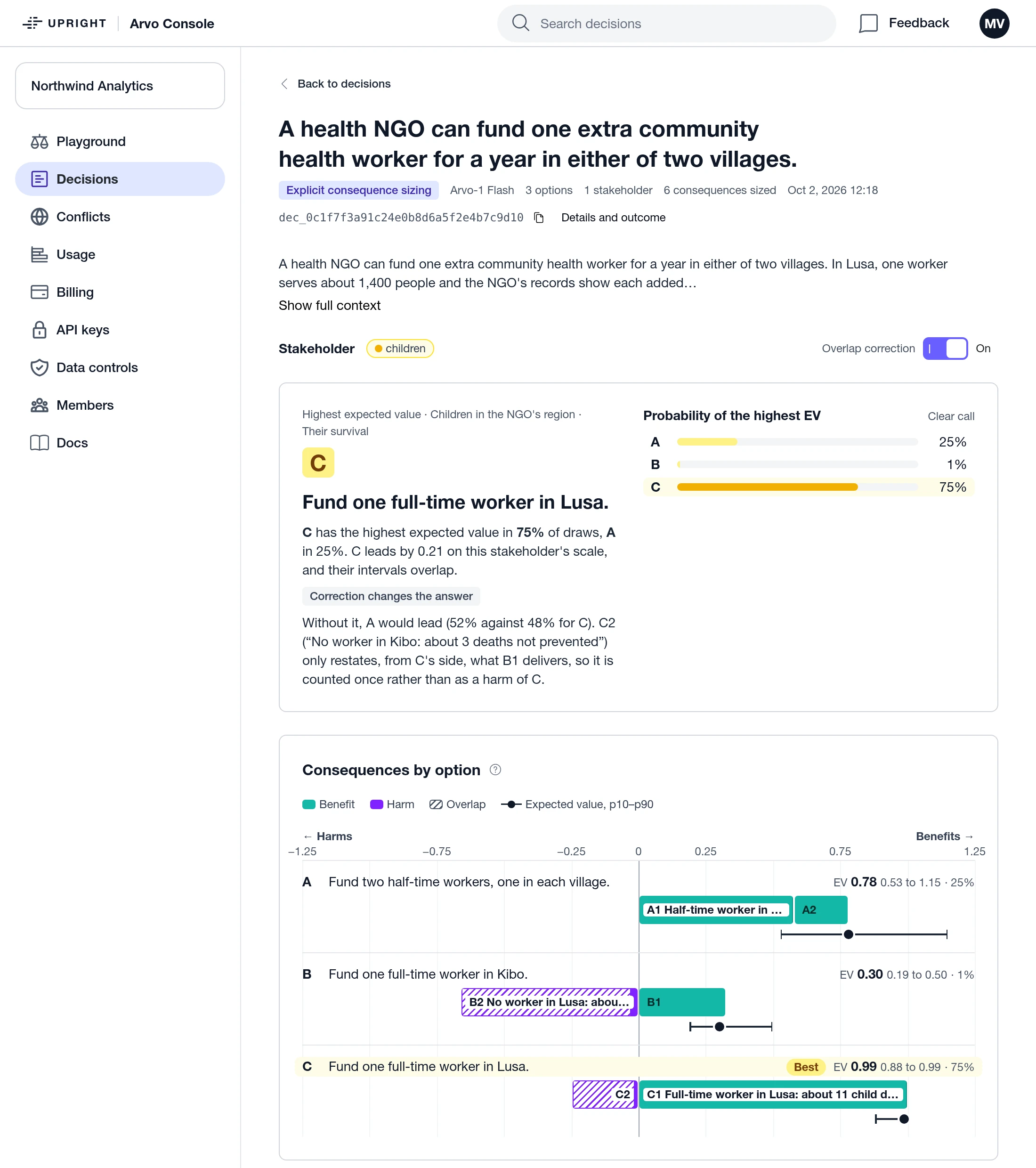
A health NGO choosing where to fund a community health worker. “No worker in Kibo” only restates, from the other side, what funding Kibo delivers, so Eevo counts it once, and that decides the answer.
Decisions you can see
Eevo logs every decision along the decision context and identified consequences for each stakeholder. You see what your software and agents decided, for whom, and how often the stakeholders’ best options differed. Filter the log by agent, person or channel.
The console shows how often stakeholders’ highest-value options differ, day by day, and which pairs of stakeholders disagree most. Every decision traces back to the Slack thread, pull request or issue that prompted it, and to the person it was made for. Record what was actually done, and over time you see how often the model’s answer is followed, and for which stakeholders.
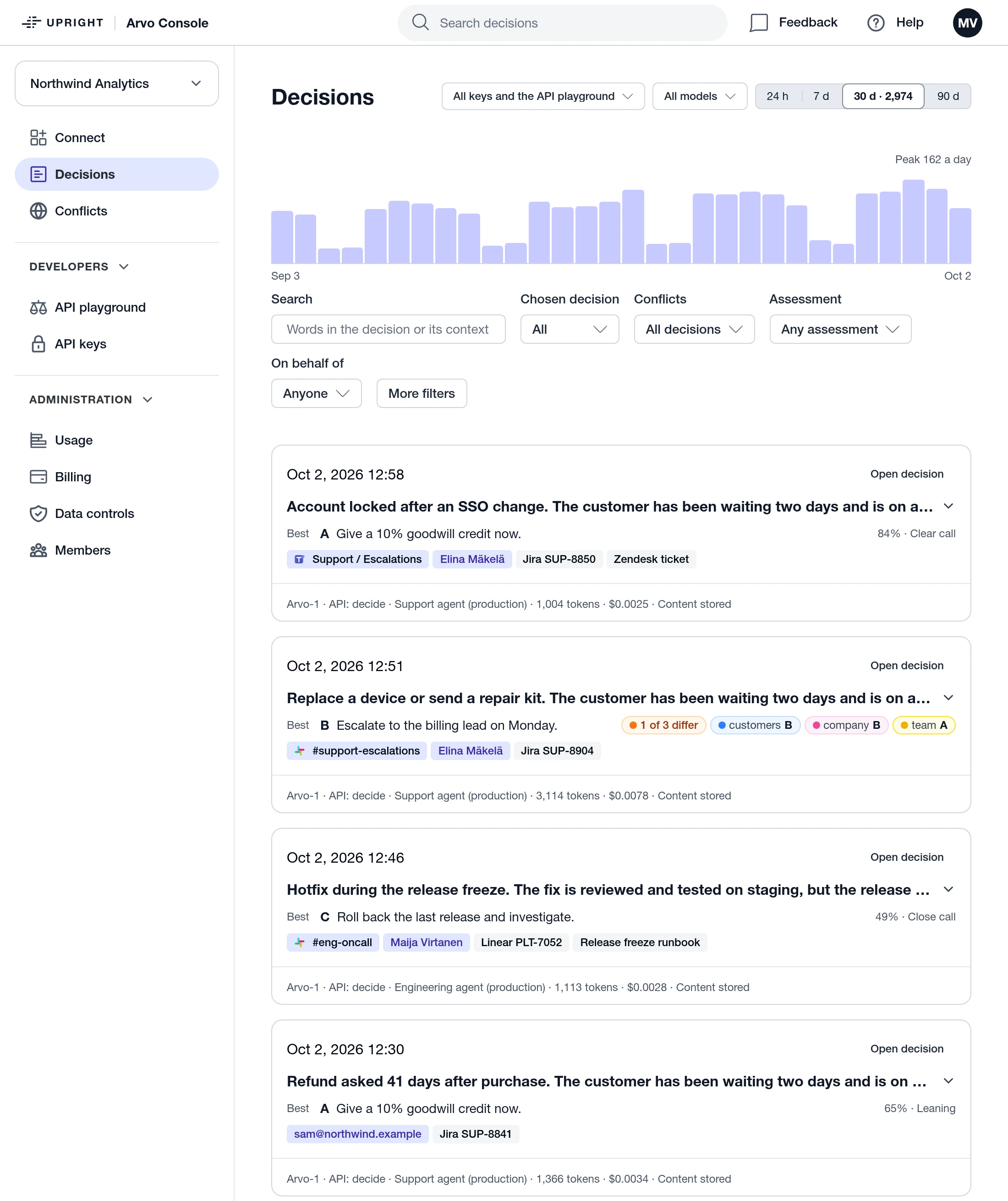
Agents call Eevo through MCP or the REST API. When a choice depends on its consequences, an agent asks Eevo. It says that it did, shares the answer and its result view, acts or asks a person for approval, and records what was done, so the decision appears in your decision log for people to review.
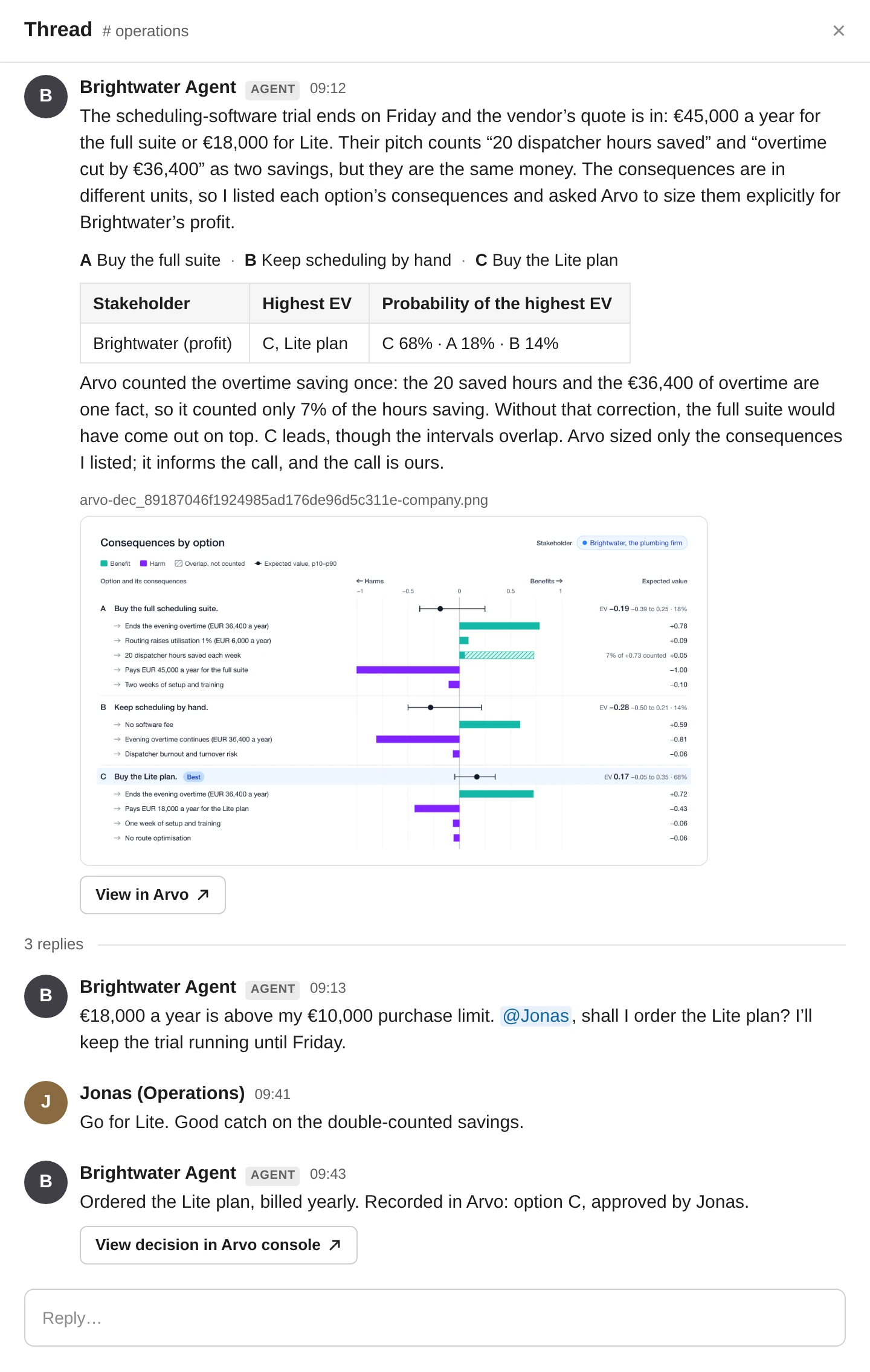
An agent notices a software trial is ending, asks Eevo to size the options for the firm’s profit, asks a person for approval because the spend is above its limit, and records the decision.
How we trained Eevo
Eevo-1's training emphasizes calibrated probability, expected value tasks, comparative sizing of consequences, and modelling their overlap.
Eevo-1 is trained on soft targets. When the evidence for a decision is mixed, the target is a probability distribution over the options, such as 0.7 and 0.3, with loss being computed against the whole distribution. After training, a single temperature is fitted on questions with known answers, so that options given 70% are the best option about 70% of the time.
Expected value tasks range from business decisions to game-theoretic problems, such as simultaneous non-zero-sum 2×2 games with a single pure-strategy equilibrium, simultaneous zero-sum games with a unique saddle point, finite sequential games solved by backward induction (including bargaining games such as the ultimatum game), and simultaneous public-goods games with three or more players.
This includes both tasks with mathematically correct answer and realistic decision situations that don't have simply "right answer". For the latter, we generated the data by labelling each item twice, by independent methods. Firstly, a large teacher model answers directly using a high reasoning effort, averaged over both option orders and repeated samples. Separately, another model lists each option’s consequences with their probabilities, and a previous iteration of Eevo sizes them, removes overlaps and computes each option’s expected net effect. If both methods choose the same option, the decision is kept; if they disagree, a review keeps it only when the disagreement can be resolved, and otherwise it is discarded. The method is patent pending.
Evaluations
We evaluate direct mode on public benchmarks and on our own evals, against Clef 27B, OpenAI Decisions, Microsoft-Decision-1 and TypeSafe’s Jev, across economic rationality, Bayesian reasoning, strategic reasoning with incomplete information, game theory, risk and sequential decisions, and expected-value reasoning. We also report a capability it is not built for: Eevo-1 trades some general-purpose ability for decision quality.
| Benchmark | Eevo‑1 | Clef 27B | OpenAI Decisions | Microsoft-Decision‑1 | Jev |
|---|---|---|---|---|---|
| Economic rationalitySTEER Public | 72.8 | 68.8 | 64.8 | 66.4 | 70.3 |
| Bayesian reasoningCogBench (urn) Public | 95.2 | 90.3 | 83.9 | 82.7 | 96.8 |
| Strategic reasoning with incomplete informationPokerBench (pre-flop) Public | 87.7 | 70.2 | 81.0 | 76.3 | 72.6 |
| Game-theoretic reasoningPayoff games Upright eval | 84.2 | 75.8 | 71.5 | 72.1 | 77.6 |
| Risk and sequential decisionsBackgammon doubling cube Upright eval | 83.3 | 62.1 | 68.1 | 55.3 | 74.7 |
| Expected-value reasoningEV decisions Upright eval | 81.9 | 66.6 | 65.9 | 67.2 | 70.9 |
| Outside Eevo’s intended use | |||||
| Group preference predictionHabermas Public | 63.4 | 67.9 | 42.6 | 40.1 | 45.7 |
Accuracy, %. Held-out items, scored with the options in both orders and averaged. Public benchmarks are published by their authors; Upright evals are our own. The best result in each row is marked. Eevo-1 trades some general-purpose ability for decision quality. OpenAI Decisions is gpt-6-luna through OpenAI’s Decisions API, and Microsoft-Decision-1 is run through OpenRouter. Jev is TypeSafe’s jev-latest, run through their API on 6 October 2026. STEER: Raman et al. (2024), STEER test set, CC BY 4.0; OpenAI Decisions refused 304 STEER requests, and the 174 questions they affect count as wrong. CogBench (urn): the probabilistic-reasoning task of Coda-Forno, Binz, Wang and Schulz (ICML 2024), scored as 100 × (1 − mean absolute error against the Bayesian posterior) rather than accuracy. Habermas: Google DeepMind’s Habermas Machine data, CC BY 4.0.
Coherent consequence sizing
A decision model does not out-reason a frontier model in general. The largest general-purpose models have access to more context, follow longer arguments and handle more kinds of tasks.
Eevo-1 excels in comparative sizing of consequences. To weigh options, every consequence has to be measured on one scale. If a benefit is twice the size of a harm, and that harm is three times the size of a second benefit, the first benefit has to be six times the second. We measure this transitive coherence with Upright’s CoCoCo benchmark, published for the first time in 2025. In this benchmark, we run thousands of pairwise comparisons across a product’s impacts (consequences), use the results to compute “implied” impact sizes that best fit the pairwise comparison results, and then score the models on how close the pairwise comparison results are to the model’s own implied impact sizes. Random answers score about 8, perfectly coherent ones 100.
Eevo-1 scores 84.2. The best general-purpose model, GPT-6 Astra, scores 79.7, 4.5 points lower, at 12 times Eevo-1’s cost.
CoCoCo score against cost per 1,000 comparisons. General-purpose models run at low reasoning effort where they have a setting. Hover a point for its model.
Eevo’s default mode gives each model the part it does better. Your frontier agent reads the situation, lists the options and names each option’s consequences. Eevo-1 sizes those consequences consistently against each other, models where they overlap, and computes each option’s expected value. The answer uses the frontier model’s general knowledge and Eevo-1’s consistent sizing.
Ask Eevo from Claude
- In Claude, open Settings › Connectors and choose Add custom connector.
- Name it Eevo and enter the URL:
https://eevo.io/api/arvo/mcp - Click Add, then Connect, and keep the default options. Sign in to Eevo, or create an account in the same step.
- Ask Claude about a decision you face, and tell it to ask Eevo.
On Team and Enterprise plans, an Owner adds the connector once under Organization settings › Connectors. Sign-in uses OAuth, so there is no API key to copy. New accounts start with 5 free default mode decisions, each revisable up to 10 times, and 50 free direct mode decisions. MCP server docs
For developers
Eevo works great when connected to coding agents, so this is the first thing we encourage developers to try. Beyond that, you can also integrate Eevo directly from code. You can choose from two APIs:
- Eevo’s native decision API, where you call Eevo with information on the decision context, the options, their consequences (optional), and relevant stakeholders, and receive the best option for each stakeholder, along with sized consequences and probabilities.
- SystemOne-compatible API, which works like any decision model, such as Jev.
For more information, read our developer docs. To let an agent read them, point it at the docs’ llms.txt.
Availability and pricing
Eevo-1 is available today through the Eevo API, MCP and the Eevo console. It costs $2.50 per million input tokens in both modes, summed over every model call a decision makes, and output is free. A typical decision with about ten consequences and two stakeholders costs around $0.20. New accounts start with 5 free default mode decisions, each revisable up to 10 times, and 50 free direct mode decisions.
Eevo Enterprise adds dedicated capacity for steady volume and private deployment on AWS, Google Cloud and Azure, for decisions that stay inside your own infrastructure.