Decision support for operations
Operations agents keep meeting situations no runbook covers: a failed job just before a deadline, or two standing rules that contradict each other. With Eevo, they can weigh each option’s consequences for everyone affected, act on the clear calls and page a person only when it matters.
New accounts start with $1.00 of free credit.
Upright is trusted by 300+ demanding organisations


















Why use Eevo for operations decisions
Eevo’s Consequence-based Decision API offers a practical way for operations agents to make sound judgment calls when no runbook applies. Fixed runbooks only cover the failures someone anticipated, and break down when two standing rules contradict each other.
When something unexpected happens, your agent sends Eevo the situation, the options and whose interests count. Eevo weighs each option for each stakeholder and returns the best one for each, with a probability. Your agent can then act on the clear calls, and page an on-call engineer when the stakeholders’ interests conflict.
The result is faster incident response, fewer unnecessary pages, and a clear record of every call for post-incident review.
Unlike generative LLMs, which tend to make inconsistent choices when goals conflict, Eevo is trained to compare consequences and assess expected value.
The nightly ETL failed at 02:10. A fix is ready, but the log dump that would confirm it arrives at 03:00, and the dashboards refresh at 06:00. Asking Eevo whether to ship now or wait.
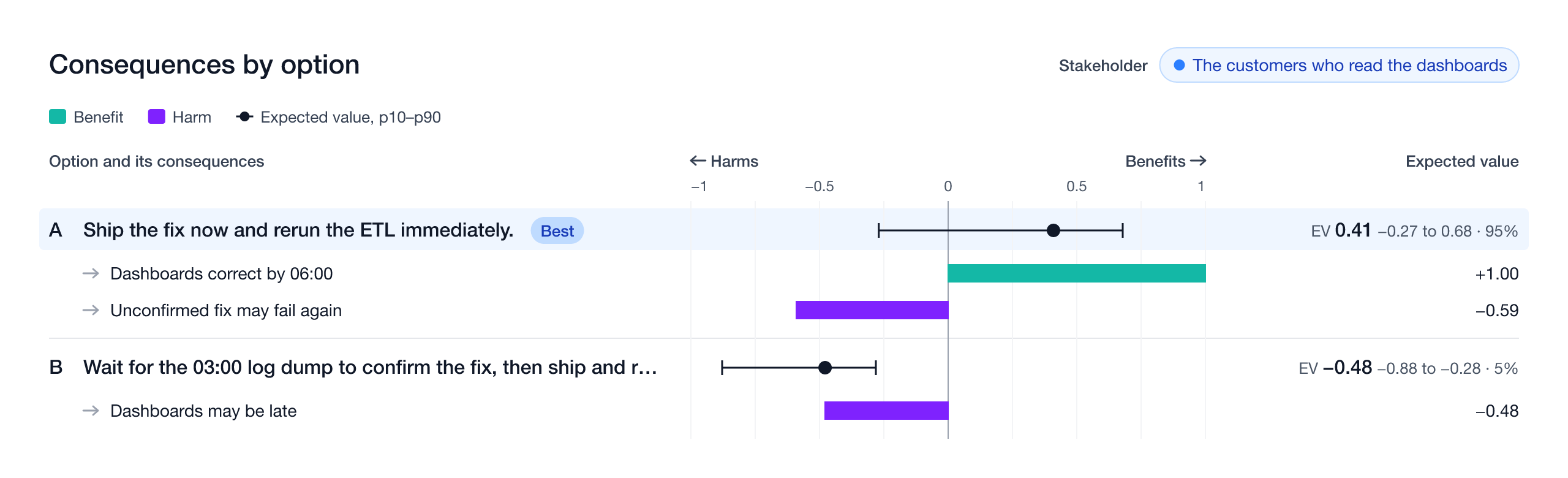
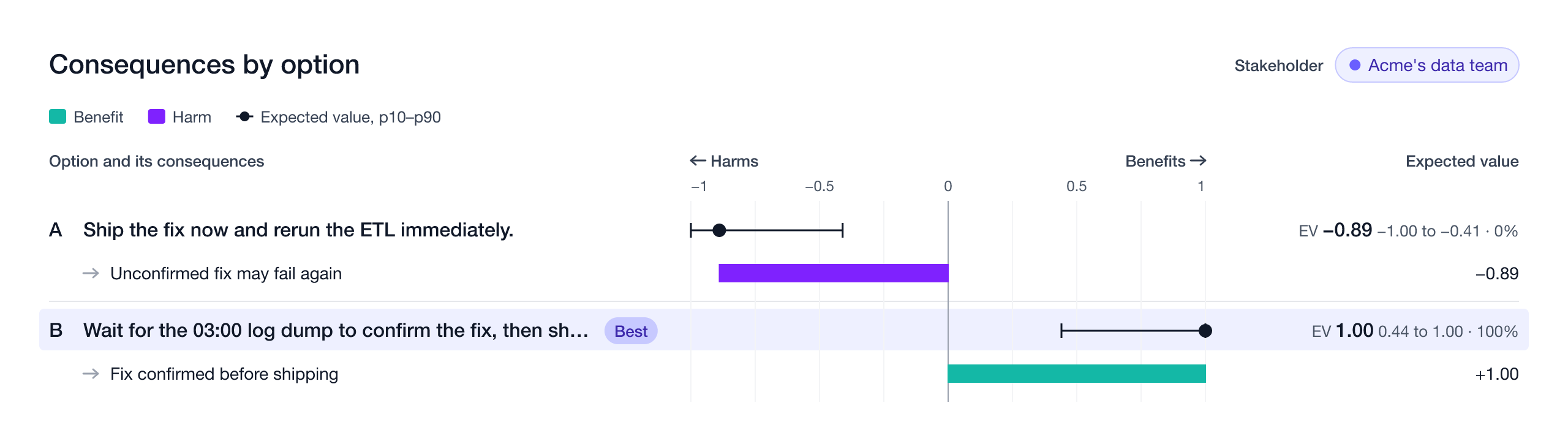
Customers are best served by shipping now (95%), the data team by waiting (100%). Since their interests don’t align, I’m not deciding alone. Aino, can you make the call?
Ship it now. I’ll check the 03:00 dump.
Shipped, and recorded the decision in Eevo.
Benchmarks
Choosing well comes down to judging how likely each outcome is, how much it matters and how the options compare. Eevo-1.4 leads other decision models on every expected-value and economic-rationality benchmark below.




| Expected-value & strategic decision benchmarks6 benchmarks · mean | 83.9 | 73.8 | 65.7 | 66.4 |
|---|
| Expected-value & strategic decision benchmarks | Upright Eevo-1.4 | TypeSafe Jev 1.14 | Microsoft Decision-1 | OpenAI Decisions |
|---|---|---|---|---|
| Decision IndexEdition 0.3 | 74.54 | 60.70 | 56.90 | 47.37 |
| Economic rationalitySTEER | 82.1% | 71.7% | 66.4% | 64.8% |
| Expected-value decisionsUpright private benchmark | 84.1% | 80.0% | 67.2% | 65.9% |
| Strategic payoff gamesUpright private benchmark | 92.1% | 81.2% | 72.1% | 71.5% |
| Risk-threshold decisionsBackgammon doubling cube | 83.7% | 74.7% | 55.3% | 68.1% |
| Game-theoretic action selectionPokerBench pre-flop | 86.8% | 74.3% | 76.3% | 81.0% |
| Consequence-based Decision API suites4 benchmarks |
|---|
| Consequence-based Decision API suites | Upright Eevo-1.4 | TypeSafe Jev 1.14 | Microsoft Decision-1 | OpenAI Decisions |
|---|---|---|---|---|
| End-to-end consequence decisionsUpright internal suite | 88.2% | — | — | — |
| Consequence sizing accuracyMagnitude & probability estimates | 92.3% | — | — | — |
| Overlap detection recallDetecting overlapping consequences | 94.1% | — | — | — |
| Pairwise ratio consistencyConsistency across pairwise comparisons | 84.7 | — | — | — |
Direct model evaluations (0–100, higher is better).
Expected-value & strategic decision benchmarks. These range from economic rationality (STEER) and Upright’s private expected-value and payoff-game suites to when to take a risk against an opponent: the backgammon doubling cube and PokerBench pre-flop. The Decision Index adds 37 public benchmarks scored for skill above chance.
Consequence-based Decision API suites. These test the whole API on Eevo-1.4, and each of its steps on its own: sizing each consequence, finding where consequences overlap, and comparing options in pairs consistently.
Start building with Eevo
New accounts start with $1.00 of free credit.