
Double materiality assessmentUpright's complete guide
What is double materiality?
Double materiality is the mechanism at the centre of the EU's Corporate Sustainability Reporting Directive (CSRD). It determines which sustainability topics a company must report on – and, done well, which ones deserve strategic investment.
The concept is straightforward: every sustainability topic is evaluated from two independent dimensions. A topic can be material in one, both, or neither.
Impact materiality examines where your business causes significant harm or creates significant benefits for people and the environment. It scores severity on four components: scale (how serious), scope (how widespread), irremediability (how reversible), and likelihood (for potential impacts).
Financial materiality examines which environmental and social factors create risks to your cash flows, market position, or cost of capital – and which present opportunities. It evaluates both the magnitude and probability of financial effects across short-term and long-term time horizons.
Materiality in either dimension is sufficient. A topic that scores high on impact materiality alone still requires disclosure, and the same applies to financial materiality alone.
The output is a set of material topics, each with documented impacts, risks, and opportunities (IROs). These IROs are the unit of a DMA's output – they determine which European Sustainability Reporting Standards (ESRS) apply to your company and which specific datapoints you disclose. But their value extends well beyond compliance: a well-constructed set of IROs informs financial planning, risk management, and gives investors the structured, comparable data they increasingly require for allocation decisions.
Impact materiality & financial materiality
A credible DMA requires rigorous, separate evaluation of both dimensions. Understanding how they interact – and where they don't – is what separates a defensible assessment from a compliance exercise.
Impact materiality: the sustainability profile of your revenue-generating operations
Impact materiality asks whether your business causes significant harm or delivers significant benefits to the environment or society.
As noted above, your product and service mix is the dominant driver. Manufacturing diesel vehicles produces significant GHG emissions; developing prescription medicines creates significant positive health impacts. Geographic footprint matters where operations or suppliers sit in regions with elevated human rights, water stress, or biodiversity risks. Broader sustainability indicators – governance practices, corruption exposure – can surface topics the first two lenses miss, but are typically secondary.
Financial materiality: where sustainability translates into money
Financial materiality asks how sustainability topics create concrete financial risks or opportunities. Two patterns dominate: impact-driven risks, where your own negative footprint circles back to your balance sheet (a pollution incident triggers fines; a product safety failure triggers recalls), and dependency-driven risks, where reliance on vulnerable external resources creates exposure (climate change disrupts crop yields for a food manufacturer; critical mineral concentration creates input cost volatility for electronics).
The two dimensions are assessed independently but produce a unified result. Sanofi's patient health and safety impact, for instance, directly implies severe financial exposure if product safety fails – the impact finding signals the financial risk. But it doesn't always work that way. What matters is that both dimensions receive rigorous, separate evaluation so your conclusions hold up under assurance.
What CSRD requires – and what has changed
The CSRD requires every in-scope company to conduct a double materiality assessment as the foundation for its sustainability reporting. Your DMA determines which ESRS standards apply and which IROs you must disclose.
The regulatory landscape shifted significantly in early 2026. Here is where things stand.
Who is in scope after the Omnibus?
The Omnibus I Directive (adopted by the Council on 24 February 2026, entered into force 18 March 2026) raised the CSRD's scope thresholds substantially. Under the revised rules:
EU companies must exceed both 1,000 employees and €450 million in net annual turnover to fall within scope. Listed SMEs, which formed the original Wave 3, have been removed from scope entirely.
Non-EU companies are in scope if the parent undertaking generates €450 million in net EU turnover and has a subsidiary or branch in the EU with over €200 million in net turnover.
A value chain cap now protects smaller companies: those below 1,000 employees can refuse information requests that go beyond the Voluntary SME Standard (VSME). This limits the trickle-down effect that the original CSRD created for suppliers.
What is the reporting timeline?
The timeline has become more nuanced post-Omnibus:
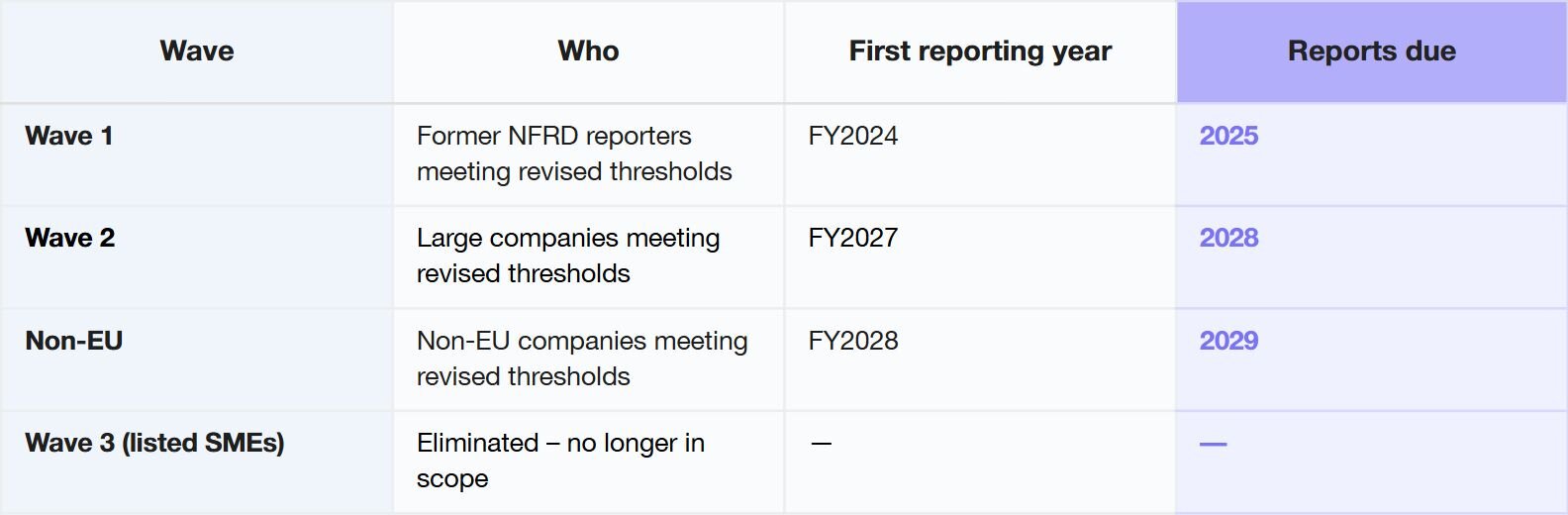
Wave 1 nuance: Companies that still meet the revised thresholds must continue reporting through FY2026. Those that fall below may be exempted by their Member State for FY2025 and FY2026 – but this is a country-by-country decision, not automatic.
What do the simplified standards mean for your DMA?
The Omnibus reduced ESRS disclosure requirements significantly and dropped sector-specific standards altogether. With less prescribed structure, the DMA is now the primary mechanism through which companies determine what they report on. The flexibility cuts both ways: it gives companies more discretion, but it also means auditors will scrutinise your materiality conclusions more carefully, since the standard itself no longer prescribes as much.
What do stakeholders expect beyond the minimum?
Institutional investors, B2B customers, and auditors increasingly expect companies to quantify sustainability risks and opportunities in financial terms – not just identify them. The simplified ESRS requires both quantitative and qualitative information on anticipated financial effects, with a phase-in period until 2029. A DMA that stops at "this topic is material" without connecting it to financial exposure is technically compliant but strategically incomplete.
Read Upright’s stance on Draft Simplified ESRS for more.
Common challenges with double materiality assessments
The DMA is conceptually straightforward. In practice, the same failure modes appear across industries and company sizes. Recognising them early makes the difference between a process that takes weeks and one that drags on for months.
- Subjectivity that collapses under audit scrutiny. Most traditional DMAs start by asking internal stakeholders to identify material topics from scratch, then score them through workshops and surveys. The result reflects who was in the room, what they already knew, and how fatigued they were by hour three. Auditors will ask how you determined what is and isn't material. Internal sentiment alone is not a defensible answer – the assessment needs to demonstrate that external data, scientific evidence, or established frameworks shaped the outcome.
- Data gathering that crowds out interpretation. Sustainability teams routinely spend the bulk of their DMA time collecting and reconciling information rather than analysing what it means. For resource-constrained teams – and nearly every team doing this work is resource-constrained – this is where the process stalls. The goal should be to minimise time on data assembly so your team focuses on what requires human judgement: evaluating context, engaging stakeholders on findings, and connecting materiality results to business decisions.
- A snapshot that can't adapt. A DMA conducted once reflects a single moment. But companies acquire businesses, enter new markets, and face evolving regulatory requirements. If the assessment can't be updated without starting from scratch, it loses relevance quickly. The companies that get the most value from their DMAs are those that treat them as living analyses – updated when the business changes, not rebuilt annually from zero.
- Material topics that never reach a decision-maker. Perhaps the most common failure: completing a DMA and then struggling to translate the results into action. The assessment identifies material topics, but connecting those findings to financial planning, risk management, and capital allocation requires a deliberate next step that most organisations underestimate. A DMA that produces a materiality matrix but no financial language for the CFO is only half done.
The process: How to do a double materiality assessment
A DMA follows a structured process from understanding your business context to producing a defensible, documented set of material topics. The specifics vary by company size, sector, and methodology, but the core stages are consistent.
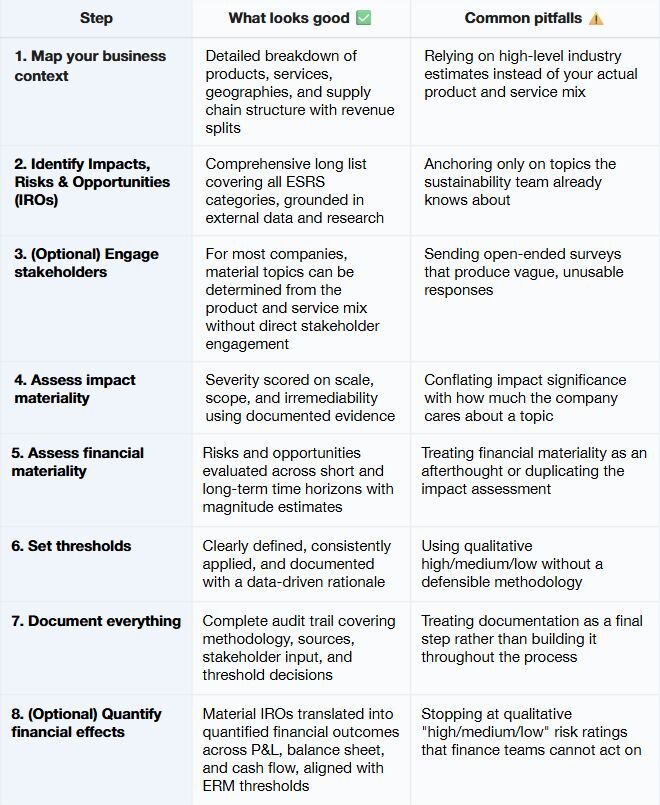
The DMA process at a glance
Step-by-step
1. Map your business context. Document your products, services, geographic footprint, and supply chain – with revenue splits, not just descriptions. This step drives everything downstream: your product and service mix determines the majority of your materiality results, so approximations here compound into weak conclusions later.
2. Identify your IROs. Generate a comprehensive long list of potentially material IROs across all ESRS categories. Comprehensiveness matters more than precision at this stage – it is better to start broad and narrow down than to miss something an auditor will ask about later. Approaches range from manual research to science-based tools that map your business activities against external data.
3. (Optional) Engage stakeholders. The simplified ESRS positions stakeholder engagement as one input alongside scientific data – not a mandatory standalone exercise. For product-driven companies, external data covers most material topics.
Scoring: impact and financial materiality (steps 4–5)
These two assessments are the analytical core of the DMA, and must be conducted independently.
For impact materiality, evaluate severity on scale, scope, and irremediability (plus likelihood for potential impacts). For financial materiality, evaluate the magnitude and likelihood of financial effects across short and long-term time horizons. The most common mistake is treating financial materiality as a copy of the impact assessment – it requires a different analytical lens, focused on cash flows, cost of capital, and access to financing.
Thresholds, documentation, and financial effects (steps 6–8)
Set thresholds that are quantitative, consistently applied, and documented – this is one of the most scrutinised steps in an audit, and "high/medium/low" without a defined methodology behind it is increasingly difficult to defend. Build your documentation throughout the process rather than at the end: the audit trail should cover methodology, data sources, stakeholder input, and threshold rationale.
Finally, quantify financial effects to turn your DMA from a compliance output into a financial planning input. The simplified ESRS requires both quantitative and qualitative information on anticipated financial effects, with a phase-in until 2029. At our February 2026 webinar, we asked hundreds of sustainability professionals whether they had calculated concrete euro or dollar values for their sustainability risks and opportunities. 10% said yes. Closing that gap is where the next wave of DMA maturity sits. You can read more about the related case study with Finago here.
Accelerate your reporting: Use our Free DMA Tool to generate your scientific baseline today.
The double materiality matrix explained
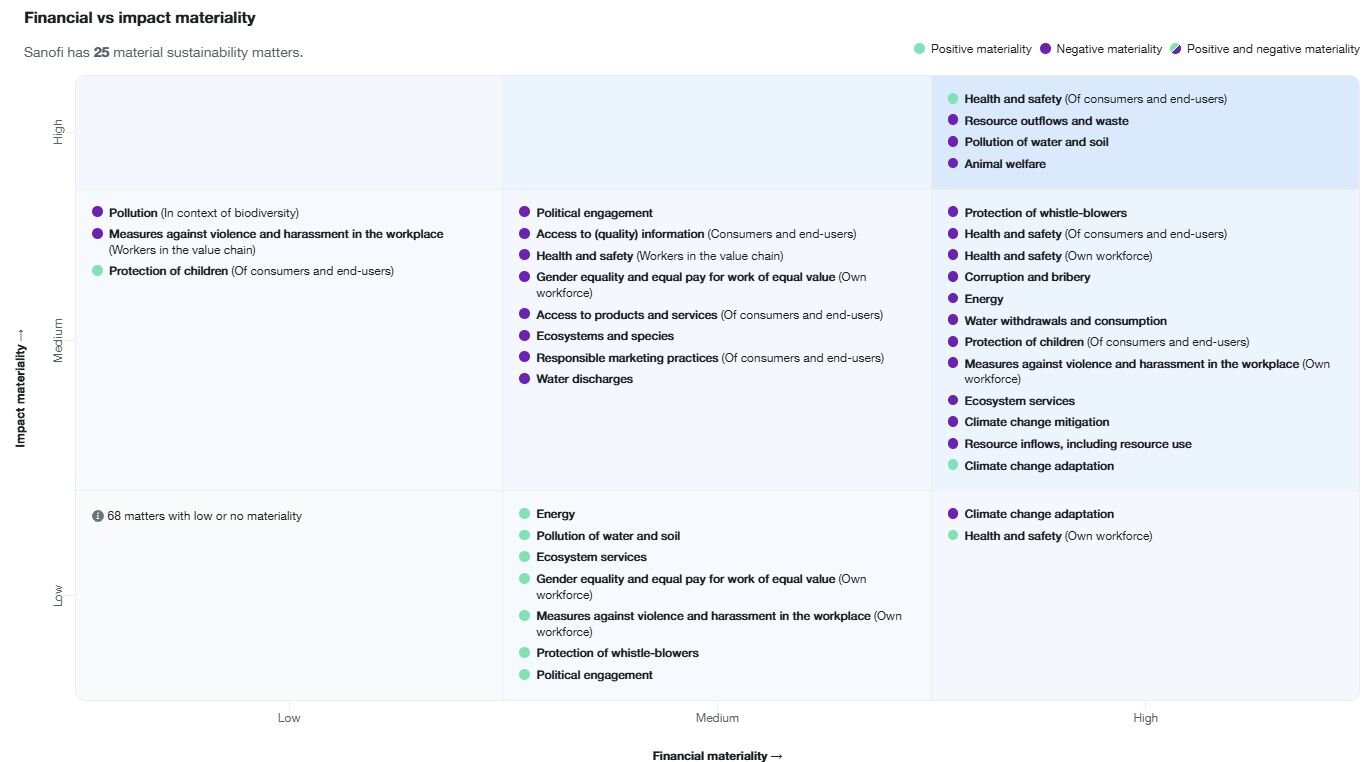
The double materiality matrix is the visual output of your assessment. It plots every evaluated sustainability topic across two axes, giving stakeholders and auditors a structured view of where your most significant topics sit.
How to read it. The horizontal axis represents financial materiality: the magnitude and likelihood of financial risks and opportunities affecting your enterprise value. The vertical axis represents impact materiality: the severity of your company's effects on people and the environment.
Topics in the upper-right quadrant are material on both dimensions – these are your highest-priority areas. Topics along either axis but not both are material from one perspective. Topics in the lower-left are candidates for scoping out, provided you can document the rationale.
The matrix is only as defensible as the thresholds behind it. Where you draw the line between material and non-material is one of the most scrutinised aspects of the entire DMA. Your thresholds should be quantitative, consistently applied across all topics, and clearly documented for assurance purposes.
A good matrix tells a story. Beyond compliance, the matrix is a communication tool. It helps leadership teams see where sustainability intersects with business risk, gives investors a structured view of exposure, and provides auditors with a visual summary they can trace back to your methodology. If your matrix can't do all three, it's missing either rigour or clarity – and probably both.
Double materiality assessment examples in practice
Traditional DMAs often spend months collecting data before producing results. A data-driven approach inverts that process: start from a comprehensive, evidence-based baseline, then refine with company-specific context. The result is faster time to insight and a more nuanced assessment that captures both positive and negative materiality across complex business models.
The following examples, derived from real assessment data, show what this looks like in practice.
Vinted, the circular economy platform
- Context: An online marketplace for second-hand fashion and goods.
- Material impact (positive): A data-driven assessment quantifies the positive impact on resource use, measuring avoided emissions and reduced demand for virgin materials.
- Material impact (negative): The same assessment flags energy use and climate change mitigation as negative impacts due to logistics and shipping between users.
- Takeaway: The DMA produces a balanced profile that validates the circular model while identifying supply chain logistics as the primary area for risk management.
See how we modeled Vinted in our webinar
Sanofi, the pharmaceutical manufacturer
- Context: A global developer of prescription medicines. Healthcare creates obvious positive impacts, but a rigorous assessment surfaces the risks alongside them.
- Impact-driven risk: Patient health and safety is flagged as highly material. The positive impact of developing medicines is significant, but the potential negative impact of side effects presents a critical risk.
- Financial connection: That impact translates into severe financial exposure. If product safety fails, it affects revenue through recalls, regulatory action, and reputational damage. A qualitative workshop might note "product safety" as a risk. A data-driven assessment quantifies the connection.
See how we modeled Sanofi in our webinar
Tools and templates for double materiality assessment
After delivering 300+ DMAs across 20+ countries over nine years, we've seen what works and what doesn't. The pattern is clear: the tools that produce defensible, useful assessments share a set of characteristics.
They start from external evidence rather than a blank sheet – because auditors will ask where your materiality conclusions came from, and "we discussed it internally" is not a sufficient answer. They benchmark thresholds against a broad dataset, not against the judgement of whoever was in the room. They minimise data gathering so your team spends its time on interpretation, not assembly. And they connect materiality findings to quantified financial effects, so the results inform business decisions – not just the sustainability report.
Upright's free DMA tool
Input your company URL, confirm your product and service mix, and receive a complete assessment across all 88 ESRS sustainability matters in minutes. Trusted for CSRD reporting by 300+ organisations.
- First DMA? Start from a science-based foundation built on 300M+ scientific articles from Oxford University's CORE database. Over 80% of materiality results come from your product and service data, so your baseline is substantive from the moment you log in.
- Already have a DMA? Use it as a data-driven second opinion. It will find blind spots – and give you a stronger defence when auditors challenge your methodology. 100% pass rate across 150+ Big Four audits to date.
